‘I remember wondering why, since I am queer, I wouldn’t rather be a girl.’ (p. 58)
‘I remember examining my cock and balls very carefully once and finding them absolutely disgusting.‘ (p. 78)
These quotations are taken from Joe Brainard’s 1975 book of prose poetry, ‘I Remember‘. I read this book during my last summer in Cambridge in 2021, a time in my life which I’ve now come to think of as my ‘crisis years’, the years that succeeded my long-coming realisation in 2019 that I’m a trans woman.
In many ways, these years were almost a black hole. Not because nothing happened. I had lots of amazing experiences during this two year stint, particularly in my friendship with Molly, which seems to be the only thing from that time I want to keep forever.
But I spent two years blocking out all the realisations that I had had. I sat in my bed at nights reading literary theory, clenching my teeth, overcome by a continuous and all-encompassing discomfort, pushing all my problems out of sight, and trying to naturalise myself as the gay man I thought it would be easier to be.
So, that summer, my final summer living as a ‘man’ (if you can call it that), I read Brainard’s ‘I Remember‘. It’s weird I hadn’t read it sooner because it ticked so many boxes for me: a fragmentary, poetic, at times Hopperesque and nostalgic evocation of midcentury America focussed through a queer, outsider perspective. Not only this, but it was published in 1975, a year that I’ve been obsessed with for some time. Ashbery published his incredible Self Portrait of the Artist in a Convex Mirror during this year.
As a result, 1975 seemed something like 1922 to me: Ulysses, The Waste Land, or, 1925: Gatsby, Dalloway. So hung up was I on the elite, masculinised literary canon that seemed to spread mysteriously behind me, that these years resonated across time.
‘I Remember‘ was quite different to these, not only because it was far more obscure, but because of its explicit queerness. While arguments can be made that Ulysses, The Waste Land, and Gatsby are all pretty gay, and I will never forget the effect the subplot between Mrs Dalloway and her childhood lover Sally had on me, they are generally a lot less explicit about their author’s sexuality than Brainard is.
‘I Remember‘, like many gay male novels I almost forced myself to read during this period in order to construct a gay identity for myself, is inflected with a male homoeroticism that, all my life, had totally disinterested me, and even, at times, repulsed me.
(I realise now that my inability to find myself attracted to men even when I think I probably am more physically attracted to them than women is because the male body, more than anything else, has always served to remind me of my own fierce, intense discomfort with my own body, which is probably a story for another post.)
The reason why I’m starting this post by discussing ‘I Remember‘, and the context in which I read it, is because I remember how that book seemed to convince me, once and for all, that I am not a homosexual.
The book was one of the most painfully beautiful I have ever read. But I read the book with a flinching discomfort at my inability to relate with it. In fact, the quotations I opened with are some of the few sections related to gender and sexuality that I found relatable. But Brainard will follow lines like those with things like:
I remember fantasises of my cock growing quite large just overnight. (A medical mystery!) (p. 78)
Which, truly couldn’t be further than what I ever wanted. While I was certainly interested in relationships, and indeed spent much of my early life overcome with desire to live my life with various women, I wanted people as far away from my cock as possible.
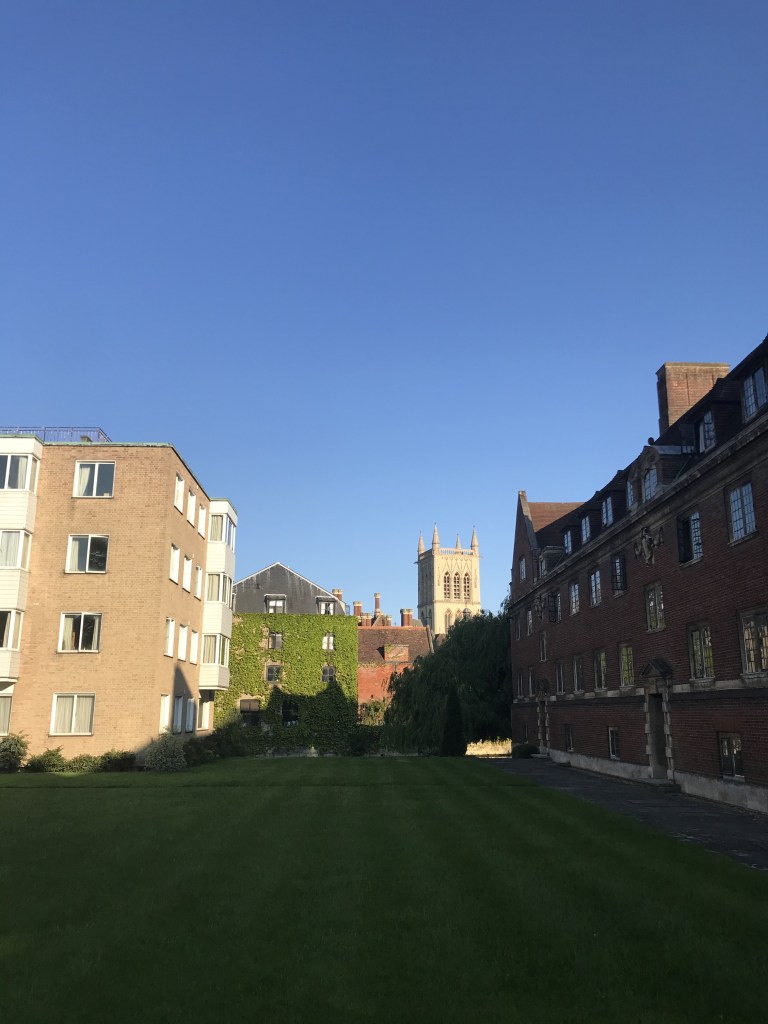
But that summer, sat in harsh sunlight by the river just outside my block, I remember that unbelievable “‘No’: this isn’t me, I’ve lied to myself.” I told no one. We drank a lot. And had a wonderful last summer in that city.

Not only was it that I’ve never felt that my attraction to men had much of an existential affect on my life, but his homoeroticism, the almost cruising aesthetic, was something that had never appealed to me.
So, I was surprised when I found an intense discomfort when reading it when I approached it precisely for a comfort and consolidation of my identity. With this disconnect, this discomfort with gay male literature in mind, I want to try and think about a canon of literature and art that actually meant a lot more to me when I was growing up.
These past few weeks I’ve started reading again, reading in a way I haven’t since I was probably 11 years old. Part of it is the sun being out, part of it is that I think I’m just more relaxed when I am on my own now. I’m not gritting my teeth.
Also, I’ve been reading Oranges Are Not the Only Fruit, by Jeanette Winterson, which Molly tells me was foundational in her own self definition and self discovery in the crisis years that preceded her coming out as a lesbian. I want to think if I had something similar, a canon of my own. And I think I did.
In this post I’m going to try to excavate that canon, and explore my relationship to this strand of intensely problematic art that represents examples of queer womanhood, specifically trans womanhood, written from a cisgender male perspective. It might also do some work to explain my profound interest in psychoactive drugs during my late teens.
Growing up, it was very difficult to find books that I really connected with. As a result, when I started reading after puberty again, I generally just read the ‘classics’ with all the baggage that entails.
In terms of queer art, the only things during that blurry, barely-remembered period called puberty that truly made me feel like I could live a joyous life in the future were two films released in 2013 that I was utterly, utterly obsessed with: those being, Dallas Buyers Club, which has a transfemme character, and to a far greater extent, Blue is the Warmest Colour– which is problematic in very similar ways to the canon I’m about to describe is.
I was clearly desperate to read stories about transness and queer womanhood. But, beyond the sensational memoirs about miraculous transformations and surgeries aimed at cisgender audiences, trans prose fiction writing wasn’t really a thing until the early 2010s.
Regardless of whether I knew about the trans writing that began to come out following the 2013 release of Imogen Binnie’s Nevada, it would have been too close to home, too ‘new’ for me, who was obsessed with the year 1925. And to have them on my shelf, the writings of transsexuals, what would that say about me?
So, I avoided the memoirs by trans women and was far more interested in older, more ‘literary’ books, written by cis men, that included transfemme characters. As can probably be expected, these books are very problematic, shot through with misogyny, far too interested in hyper sexualising their trans female characters, who, in a reflection of their position in society at the time, often inhabit the margins of the books they’re in.
One of these books, which I loved intensely, and, like Blue is the Warmest Colour, or Dallas Buyers Club, paradoxically offered me what felt like a chance to life a happy life in the future, was Hubert Selby Jr’s Last Exit To Brooklyn (1964). The book is famous for its disturbing, graphic content, drug use, sexual violence, crime, amongst many other things as it details the lives of various marginalised peoples living in deprived areas of Brooklyn in the 1960s.
But what I loved was its second chapter, The Queen Is Dead, from which The Smiths album takes its name. In this chapter, and this chapter alone, we hear the story of Georgette, a young trans woman living in Brooklyn, and, in the course of a night, watch as she fails to catch the attention she wants from the man she loves, Vinnie, before overdosing on benzedrine and dying at the end (hence the title).
The chapter, which is a discrete story in itself, opens: ‘Georgette was a hip queer.’ I found that line so cool. At times, Selby Jr. shows a great deal of sympathy to Georgette and her plight, at others, he pokes fun, making a joke at the end of the first paragraph about her, ‘occasional wearing of a menstrual napkin’ as a parodic and entirely futile gesture towards a cisgender status she can never have.
He goes on: ‘she was in love with Vinnie and rarely came home while he was in jail, but stayed uptown with her girl friends, high most of the time on benzedrine and marijuana’.
Again, I thought this was so cool. The almost Romantic (capital R), futility of Georgette’s life, her careless, recklessness, her youth, her drug use- made her seem like the coolest person in the world. Why didn’t Vinnie love her?! I knew I did.
Indeed, the years when I read this, 2017 or 2018, were the years when I still believed I was cis, but simultaneously believed to the core of my soul that to be transfemme was the coolest, the most punk, the most fuck you, I love this even though everything in society is precisely set up to discourage it, the most radical thing anyone could ever do.
In fact, during this time I saw it as an equally radical act that cis and trans women alike chose to live as women. That was why I loved and admired them.
Another section, only one line later, always stuck with me: ‘she had come home one morning with one of her friends after a three day tea party with her makeup still on and her older brother slapped her across the face and told her that if he ever came home like that again hed kill him’.
Aged 17 or 18, I felt so much for Georgette, and wished I could have been there for her. At the same time, I learned how transmisogynistic violence is routinely used to police the ways that people can live their lives.
The chapter goes on, it is very tragic. Georgette is sexually humiliated trying to win over Vinnie at a party while on drugs, overdoses, and dies. These stories clearly had some effect on me as as I subconsciously tried to construct a futurity for myself. In my crisis years I would whitey a lot.
Another of book in this makeshift canon that I read during this time period before university was Myra Breckinridge (1968) by Gore Vidal. More widely known for his pioneering gay male novel, The City and the Pillar (1944) (which I read in the later crisis years and hated), Gore Vidal was precisely the kind of male literary figure I needed to legitimise my fascination with transfeminine characters and stories.
While Myra Breckinridge is sorta forgotten now, when published in 1968, it was a huge success. Like the trans memoirs of the time, it sold the sensational story of gender transition to a cisgender public. It was, in fact, the first novel to include a gender affirming surgery in its plot.
In a layered, artificed, almost transatlantic prose, Vidal tells the story of Myra Breckinridge’s transition from Myron into a powerful, even megalomaniacal ‘new woman’. Unlike Georgette, who lives in the slums of Brooklyn, Myra is middle class, and able to access gender affirming care. The novel is intensely problematic, definitely transphobic, but still totally absorbing.
For example, the novel opens: ‘I am Myra Breckinridge whom no man will ever possess.’ Fascinatingly, Vidal positions the scariness of Myra, the disruption she poses to cisheteropatriarchal power structures, as her refusal of male possession. This is interesting because in many cases the decisions of trans women to transition are often framed as a form of complicity with these power structures: a decision to become attractive to the male gaze, to affirm the heterosexual matrix, etc.
But, for Vidal’s Myra, and in many ways for me at the time, the choice to be a woman was not a conceding to men but a refusal of them, a rejection of the male body that even I myself possessed, and an affirmation of female corporeality. Myra is a living and breathing rejection of patriarchy, and that is why she is so terrifying, and that, ultimately is why she must detransition at the novel’s end.
(I remember one scene where Myra passes out from mixing too much gin and marijuana.)
She settles down, living as Myron again, with a character called Mary-Ann in a heterosexual relationship. An ending which I saw coming, but always chose to ignore.
So, this was a case much like all the others of this canon I’m constructing: Vidal lent a literary currency, a supportive structure that told me it was okay to read these books, and that my intense fascination with them only mirrored the fascination the cis male author themselves had clearly felt to write them. I could have them on my shelves and they were just famous books.
I also read John Rechy’s City of Night (1963), a novel ostensibly about gay male sex work and cruising a dazzling New York City at Night. But I was interested in the one, briefly mentioned transfemme character. I remember being euphoric when Rechy called her ‘she’. I was like ‘wow, people can just do that’.
Later, in my first year of university, I read Jean Genet’s Our Lady of the Flowers (1943), a highly poetic novel about various gays, bi men and trans women living and fucking each other in bohemian, very poor, streets of Paris. Eventually, the book progresses to a point where all morality is inverted: where the most taboo sexual acts, crime, theft, are represented as the highest moral good. Like many other things, I saw this as so cool. When I read ‘she’ and knew that ‘she’ was trans, I almost smiled each time.
I also want to mention how much I loved T. S. (Trans. Sexual.) Elliot’s character of Tiresias in The Waste Land (1922), an AMAB person who became a prophet after transforming into a woman (and, annoyingly to me at the time, back again). As for Vidal, it seems, to become worthy of being listened to, the transfemme needs to come back into the common language of the heteropatriarchy, to detransition, to have anything comprehensible or worthwhile to say to a cis audience. I didn’t know why they couldn’t just stay that way. I loved them as they were.
When I began my love affair with the poetry of John Ashbery, I was quick to read his late collection Girls on the Run (1999), which took the extreme maximalist art work of outsider artist Henry Darger and turned it into poetic form. Darger’s work, titled, The Story of the Vivian Girls, in What Is Known as the Realms of the Unreal, of the Glandeco-Angelinian War Storm, Caused by the Child Slave Rebellion was about a group of young princesses who battled against evil adults. The art book is full of sudden, extreme, gory violence, and is very disturbing. But the part that was of interest to me was that whenever he drew these girls they had penises. Scholars are not in agreement as to why this was the case, and sometimes even speculate that the lonely janitor who created the art had never seen a cis woman’s genitals. Who knows.
I was going to leave this little tour of some of the books that I used to subconsciously construct my latent trans identity (before I felt safe to transition) here. But, last night I got to listening to Lou Reed, an artist who I listened to near constantly during the time period I’ve been describing: where I was trans in my head and transness was the coolest thing ever but I was not really trans because I only loved trans women didn’t want to be one I just loved everything they did and the mere concept of their existence and was only interested in the literary formally radical fuck society and institutions way these cis men who wrote about them were anyway. Huh.
So, to end with, I’m gonna write about Lou Reed lyrics. Perhaps more-so than even some of these more explicit queer-coded pieces of literature, it was particularly okay for me to love Lou Reed. Not only did I come from a very punk/post punk influenced family, but Reed almost created this whole genre of music, including arguably Shoegazing, when he was a part of the Velvet Underground in the late sixties.
For my late teens, when asked what my favourite song was, I would invariably say ‘Heroin’. But of more interest to me now are the songs from his later solo album, Transformer (1972)(interesting title). From this album, which I listened to constantly in the summer before university, I especially loved two songs, ‘Walk on the Wild Side’and ‘Make Up’.
Everyone knows ‘Walk on the Wild Side’, its lyrics about various trans women who were in Lou Reed and Andy Warhol’s orbit at the time, and its opening:
Holly came from Miami, F.L.A.
Hitch-hiked her way across the U.S.A.
Plucked her eyebrows on the way
Shaved her legs and then he was a she
She says, “Hey, babe
Take a walk on the wild side”
Said, “Hey, honey
Take a walk on the wild side”
But you might not know much about Holly Woodlawn, the trans woman Reed describes in the opening verse. Holly Woodlawn was so cool. Here is a picture of her from the time:
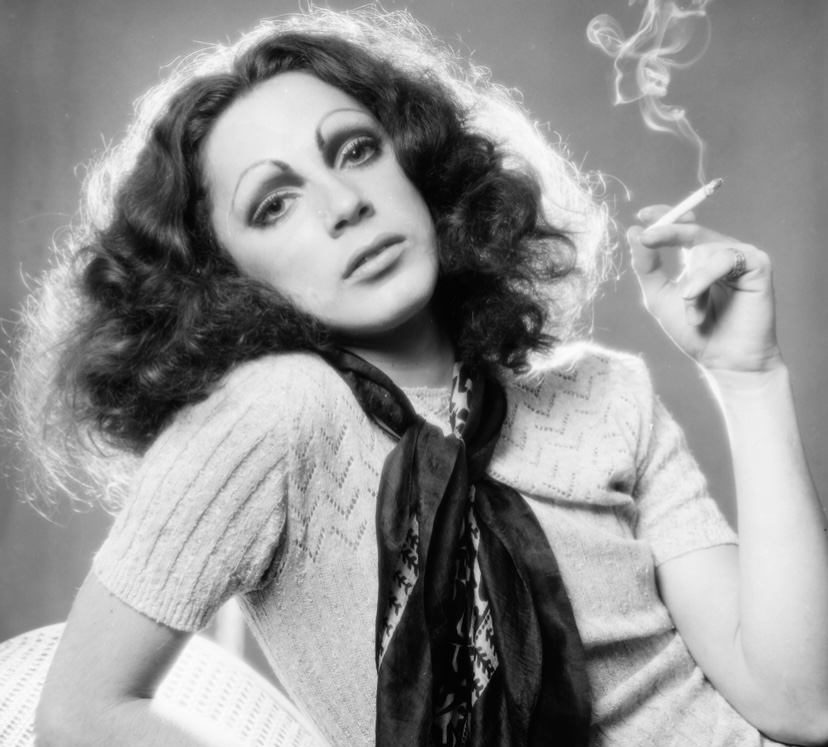
Wow, I’m still sorta in love with her. As the song describes, Holly left her hometown for the biggest city in the nation and became a ‘she’. For me this became almost the archetypal narrative of liberation. I awaited university anxiously.
In many ways all of these novels I’ve mentioned represented the kind of ‘wild side’, the inversion of the morality I’d grown up in, that I had always craved.
Another song on Transformer, and perhaps the one I would find most overwhelmingly beautiful, and exciting, is Make Up. The song, like seemingly all of Reed’s love songs from the period, was about a trans woman he was in love with:
Your face when sleeping is sublime
And then you open up your eyes
Then comes pancake factor number one
Eyeliner, rose hips and lip gloss, such fun
You’re a slick little girl
You’re a slick little girl
Aged 18, I was enchanted by this song, the absolute beauty of it, the possibility, even if I now see its tired association of transfemininity with artifice, particularly make-up. But the exquisite beauty of the bedroom scene, the ‘face when sleeping’, always threw me into reverie. I really recommend you listen to this song. Please do. I’ll link it here. It’s beautiful. It meant everything to me.
When you’re in bed it’s so wonderful
It’d be so nice to fall in love
When you get dressed I really get my fill
People say that it’s impossible
This was a romance that made me crazy. Not only this, but the song, though an often overlooked for others on the album, actually preaches a radical queer politics for the time:
Now, we’re coming out
Out of our closets
Out on the streets
Yeah, we’re coming out
For 1972, this is pretty brave. I remember frequent discussions about Lou Reed in my first term of university with my very conservative and transphobic friends. We all liked Lou reed, especially Transformer. I used to say: ‘no I love Make Up. I love it. Have you heard the lyrics?’
In Lou Reed’s other work I also loved his !1975! album ‘Coney Island Baby’, a full length album about his intense love affair with, guess what, another trans woman, called Rachel Humphreys. From his time with The Velvet Underground, the even more experimental and radical White Light/ White Heat (1968), which in the song ‘Lady Godiva’s Operation’ told the story of a trans woman being lobotomised to ‘cure’ her of her transness (link here).
During the course of the surgery, Lady Godiva, who is presented as a powerful and authoritative seductress in her everyday life, begins to regain consciousness. She starts screaming, and the doctor removes his ‘blade cagily slow from the brain’ only for the song to conclude, with Reed voicing the doctor or his accompanying nurse in a flat deadpan, ‘the head won’t move’.
The lobotomy is botched, she dies. Like so many of this depictions of trans femininity, even where transfeminine characters are presented as innocent or inspiring, they much die or detransition. Kill your transes.
In a disturbing inversion (pun not intended) of the usual obsession with trans genital surgeries, the song surprises us with another, very different surgery: one which was used, primarily against women, often queer women, to reassemble them within the psychic confines of the cisheterosexual matrix.
Also, on the same album, there is also ‘Sister Ray’, an excellent song about a drug-infused orgy between Reed, and several other people including a few ‘drag queens’ in which Reed is continuously ‘searching’ for his ‘mainline’ and trying to reinject himself with heroin to keep the dazed sexual energy going (link here). At the end of the 17 minute song, police break in and murder them all. To this day, it is my favourite mega long song. The guitar in it is stunning!
Their later, self-titled album, The Velvet Underground (1969), opens with ‘Candy Says’ a song about Candy Darling, the other trans woman mentioned in ‘Walk on the wild side’. The song opens:
Candy says, “I’ve come to hate my body
And all that it requires in this world”
How curious. How interesting. How very un-Joe-Brainard.
But, while I loved these Lou Reed songs, and felt personally liberated by them, it is vital that we note the fucked up power dynamics within them. At the time, the trans women who Reed periodically loved and then dropped, were living on the absolute margins of society. And, like many cis women, they could only be the muse- and they were indeed his muses- they could not write, could not create art.
While Reed did a lot to increase the presentation of trans women- imagine Walk on the Wild Side being on the radio!- even if they did indeed censor the line about ‘giving head’!- he did also fail to campaign for their liberation, and reinforced his patriarchal artistic power by letting them be nothing other than an art object, a beautiful, deviant, radical muse, but a muse nonetheless. Ones whom, presumably, Reed and Warhol felt leant a suitable hipness to their white, cis maleness.
On the topic of muses, my master’s dissertation began with the opening premise that the medical diagnostic criteria through which the condition of being ‘trans’ is still defined actually positions the ‘transsexual’ and their body, as something closer to its poetic muse than its object of study or its patient.
Far from mere clinical, objective observers, medical professionals, like Reed and Warhol, have tended to take a misogynistic and personally, often sexually motivated, interpretation of trans life. (I remember Blanchard and Michael J. Bailey, drooling over their taxonomic invention of the ‘homosexual transsexual’.)
There’s a lot to be said about the various trans women who became muses of major cis male artists in the twentieth century. Like Salvador Dali’s long term transgender muse, Amanda Lear, who certainly had a role to play in his ideas about the surreal. I’d also like to know a lot more about how Lili Elbe, an early trans woman to receive genital surgeries, acted as a muse for her wife, the painter Gerda Wegener, though ,as you might expect, the power dynamics are quite different in this non-heterosexual, highly complex, pairing. Someone should write a book on this topic, if they haven’t already.
So, I guess what I’ve been saying in this whole thing is that these pieces of art liberated me by showing me a magical, radical future in which I felt I could exist. But, at the same time, I used the cis male author figures to distance myself from their trans characters. I used their cis maleness as a layer of separation that kept me distant from the revelation that I am trans. Which, as I have written elsewhere, was a revelation ‘ever growing in proximity’ during these years. One year after my Lou Reed summer I realised I was trans, and would’ve transitioned then, were I not in a cishet relationship that was killing me, and in a friendship group that when it came to trans people was ambiguous at best and explicitly hateful at worst. Time moves fast.
These last weeks have been weird. I’m adjusting to the new crazy hormones I’m on, and spend my time by turns irritable and low, other times intensely clearheaded and full of ideas to write down in a way I haven’t felt for years.
This is also the week that the scum that is the UK government are turning schools into full time conversion therapy camps to eradicate young trans people from existence. It makes me physically sick. I want nothing to do with it.
Anyway, I’ve been reading those trans books, written by trans people, that have been increasingly published since 2013. I’ll do a separate post on this canon but suffice it say that it’s been a long time coming. I’m working through the internalised transphobia and internalised misogyny that made me need my transness filtered back to me through cis maleness, even if I still think those works are amazing.
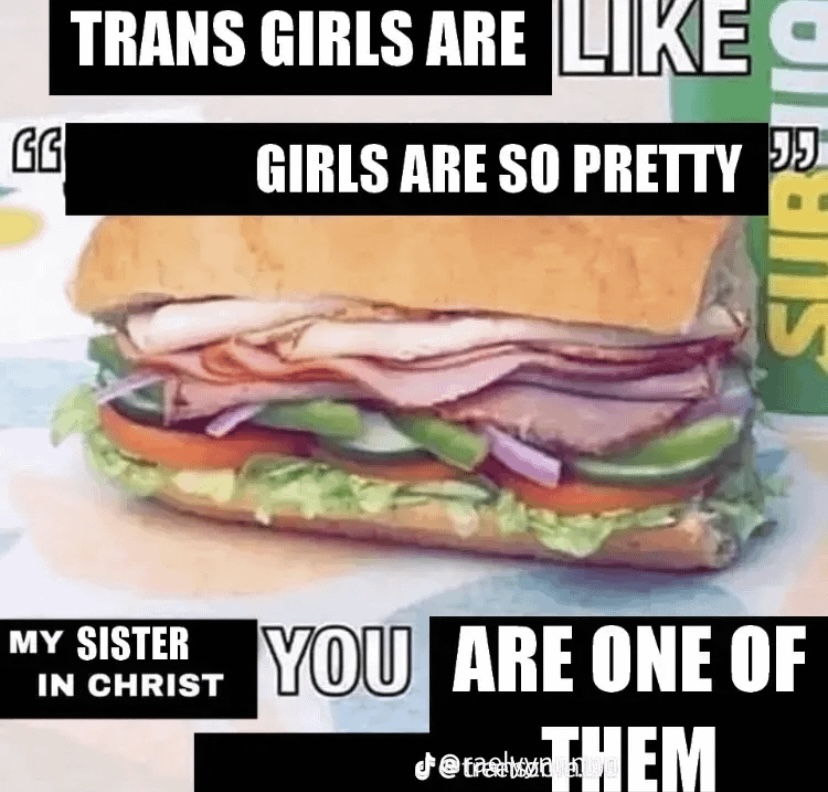
I’ll end with a meme which is honestly too damn relatable.
Love, Freya x
24/06/23

 Freya-Onions-report
Leave a reply to Reading 12: On Bailey – Freya-Onions-report Cancel reply